

Vancouver, British Columbia–(Newsfile Corp. – November 4, 2026) – Great Pacific Gold Corp. (TSXV: GPAC) (OTCQX: GPGCF) (FSE: 0B3) (“Great Pacific Gold”, “GPAC” or the “Company”) provides an update on diamond drilling and regional exploration at its flagship Wild Dog Project (the “Project”) in East New Britain Province, Papua New Guinea.
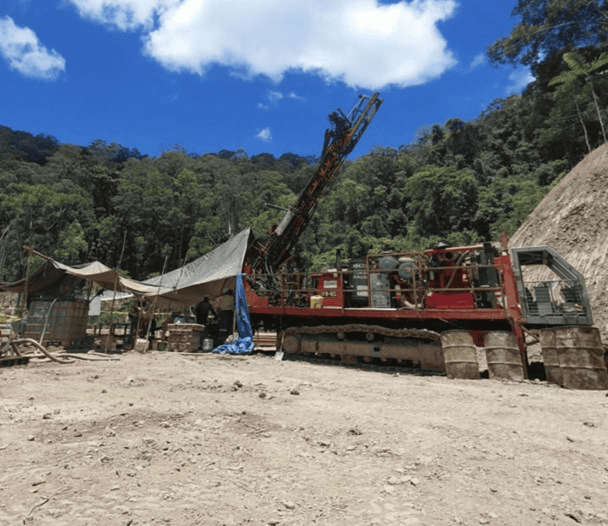
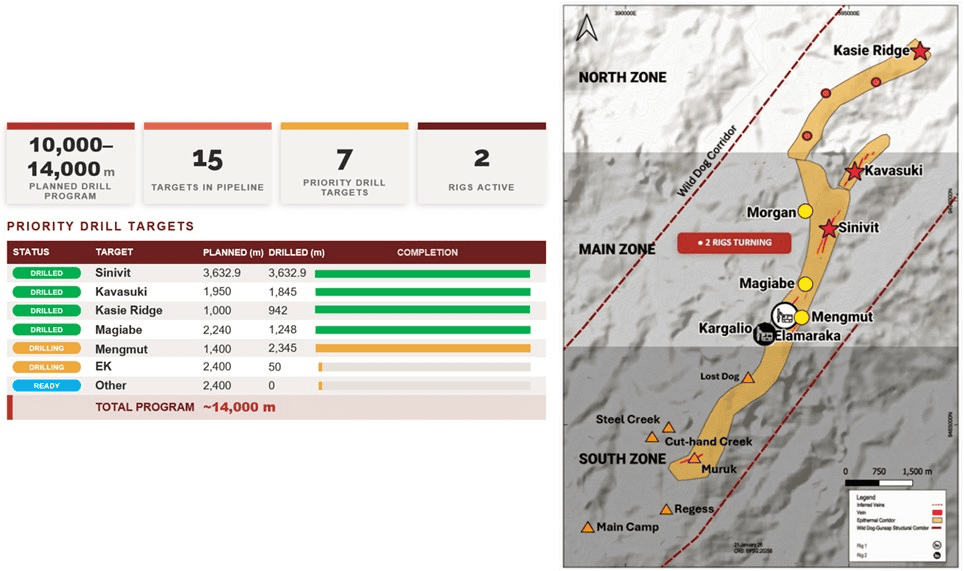
The Company has completed 16 diamond drill holes totalling approximately 3,600 metres at Magiabe and Mengmut during the current drilling phase, bringing drilling at Wild Dog in 2026 to more than 7,200 metres (Figure 2). Assay results remain pending and will be reported in complete batches for each target once all results have been received and validated.
In the meantime, drilling has commenced at the Elamaraka-Kargalio (“EK”) Target Area, approximately 2 kilometres southwest of the historic Sinivit mine. Elamaraka is an exciting new target where previous surface sampling returned 9.0 metres grading 4.81 g/t gold, including 1.0 metre grading 26.86 g/t gold. Geophysical surveys have also identified potential extensions of the mineralized structures at depth, which the current drilling program is designed to test.
Highlights – Wild Dog Drilling Update
- Magiabe and Mengmut drilling nearing completion: Sixteen holes totalling approximately 3,600 metres have been completed across the two targets, with one final hole planned at Mengmut.
- Assay results pending: The Company intends to release complete results for each target following receipt of the remaining laboratory assays and completion of quality-control reviews.
- Maiden drilling underway at Elamaraka: The first drill hole commenced October 30, 2026, targeting the potential depth extensions of previously identified high-grade gold mineralization at surface.
- Continued exploration across Wild Dog: Additional drilling and surface exploration are planned as the Company advances multiple targets along the Wild Dog corridor.
“Our drilling at Magiabe and Mengmut has substantially improved the geological picture along this part of the Wild Dog corridor. At Mengmut, nearly every completed hole has intersected the targeted structural zone over approximately 850 metres of tested strike, with the strongest alteration and brecciation observed toward the southwest. That is encouraging, but assays will be needed to establish metal grades and inform the next phase of drilling.
With the Magiabe program complete, we have moved directly into maiden drilling at Elamaraka, where high-grade surface results and coincident geophysical targets provide a compelling reason to test the vein system at depth. We expect a substantial pipeline of assay results from these programs as final certificates are received and validated,” said Callum Spink, Chief Operating Officer and Vice President Exploration.
Elamaraka-Kargalio (EK) Target Area – Maiden Drilling Underway
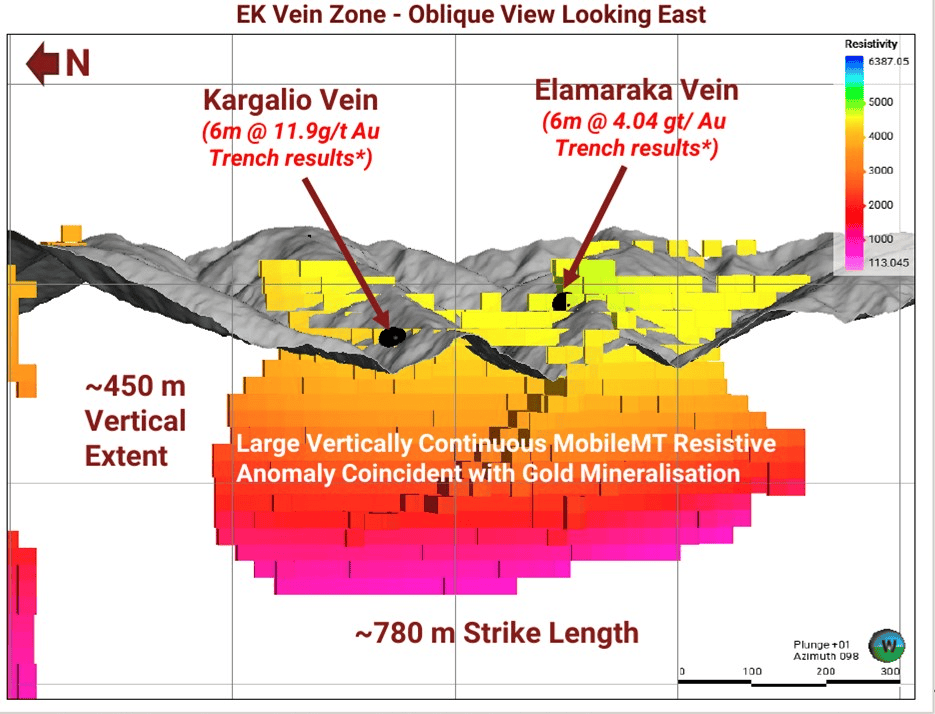
The EK Target Area lies approximately 2 km southwest of Sinivit within the southern Main Zone. Quartz-sulphide veins and fault-shear structures occur along the Sinivit-Kavasuki trend. Previously reported 2026 channel sampling returned 9.0 m @ 4.81 g/t Au, 41.96 g/t Ag and 0.02% Cu at Elamaraka, including 1.0 m @ 26.86 g/t Au and 233.4 g/t Ag. At Kargalio, channel sampling returned 6.0 m @ 7.29 g/t Au, 12.83 g/t Ag and 0.24% Cu, with mapped mineralized structures reaching approximately 11 m in apparent width (August 13, 2026 release).
MobileMT data identify resistive anomalies spatially associated with surface mineralization at both systems. At Elamaraka, a west-dipping resistive lineament is interpreted to extend to approximately 450 m depth; at Kargalio, a north-south feature extends approximately 800 m along strike and to an interpreted depth of approximately 420 m. Their geological significance remains to be established by drilling. Two drill pads at EK are complete, further pad construction is underway at Kargalio, and the current program plan is 10-12 holes for approximately 2,400 m (Figure 3).
ELM001 commenced October 30, 2026 from pad WDP-EL-002. Planned to approximately 300 m at a dip of -55° and azimuth of 347°, the hole is designed to intersect the interpreted southeast-dipping Elamaraka vein at approximately 65-85 m downhole, beneath the high-grade surface channel (Figure 4). A second interpreted silicified structure is targeted at approximately 270 m downhole (Figures 5 and 6); if the structure projects deeper than interpreted, the hole will be extended beyond its planned depth until it has been drilled through. ELM001 had reached approximately 50 m at the date of this release.
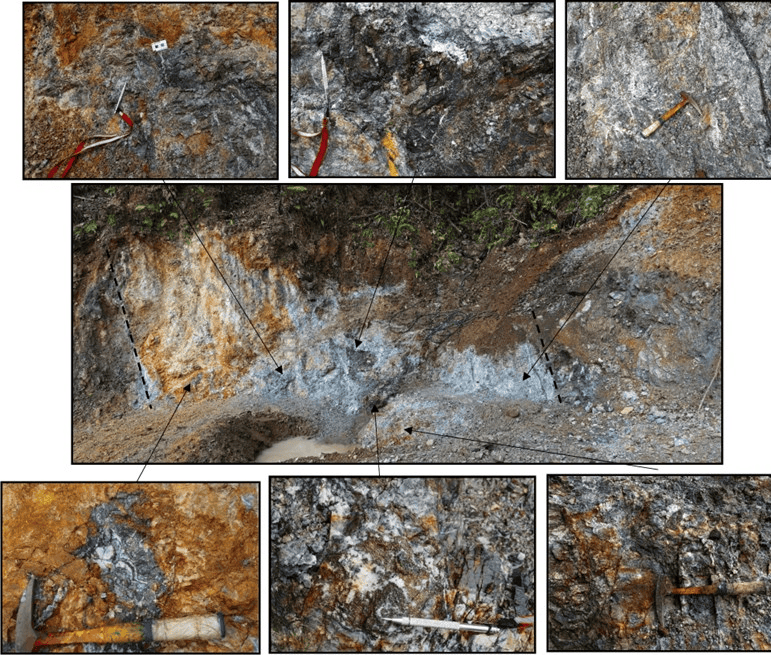
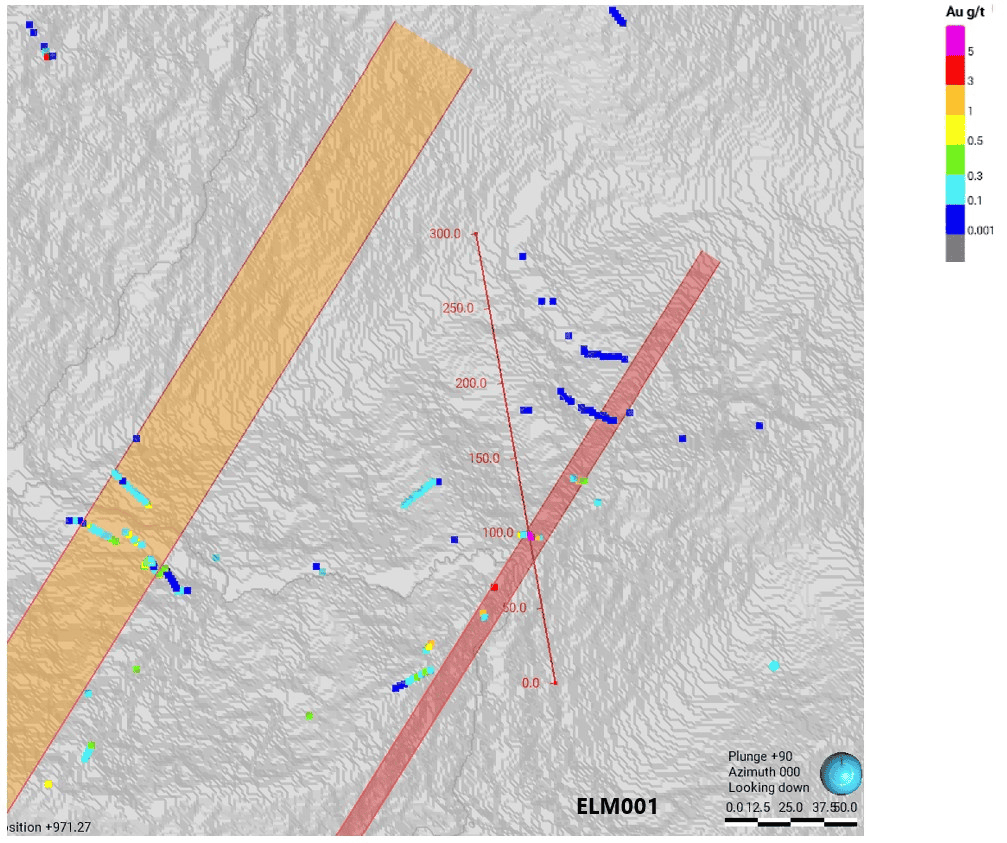
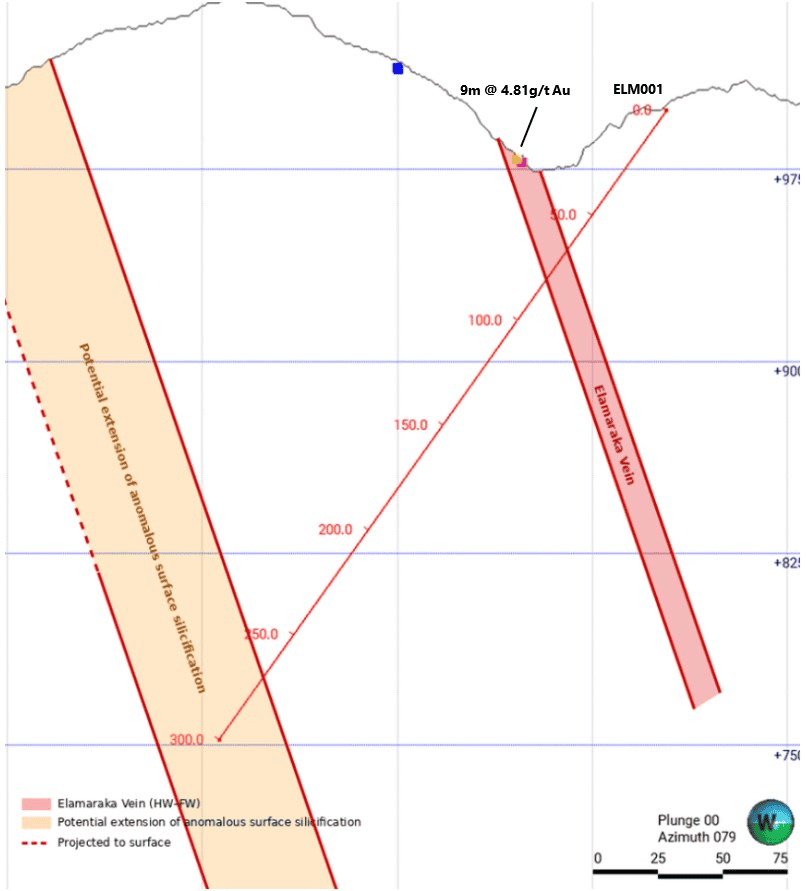
Table 3: Elamaraka Drill Hole Details (PNG94 UTM Zone 56 coordinates).
| Drillhole | Easting | Northing | Elevation (m) | Dip (°) | Azimuth (°) | Depth (m) |
| ELM001 | 393210 | 9486897 | 998 | -55 | 347 | In progress |
Magiabe – Five-Hole Drill Program Complete
Magiabe is a structurally controlled, epithermal gold-silver-copper target approximately 700 m southwest of the historic Sinivit mine (Figure 2). Historical trenching returned 4.2 m @ 10.93 g/t Au, while historical drill hole 90MGD004 returned 4.4 m @ 9.23 g/t Au and 37.9 g/t Ag. In 2026, surface sampling identified the subparallel Magiabe West Vein approximately 100 m west of the Magiabe Vein. Channel sampling returned 8.0 m @ 17.10 g/t Au, 7.63 g/t Ag and 0.67% Cu (18.24 g/t AuEq), including 3.0 m @ 45.26 g/t Au (previously reported August 5, 2026; historical results are unverified – see Notes). Five holes totalling 1,248.0 m were completed between July and October 2026. The first favourably oriented drill test of these structures will help refine the geological model once assays are received.
Table 1: Magiabe Drill Hole Details (PNG94 UTM Zone 56 coordinates).
| Drillhole | Easting | Northing | Elevation (m) | Dip (°) | Azimuth (°) | Depth (m) |
| MGH001 | 394085 | 9488095 | 1019 | -65 | 292 | 287.80 |
| MGH002 | 393917 | 9488322 | 928 | -50 | 135 | 174.50 |
| MGH003 | 394034 | 9488187 | 986 | -58 | 317 | 268.10 |
| MGH004 | 394034 | 9488187 | 989 | -68 | 235 | 269.00 |
| MGH005 | 394084 | 9488094 | 1019 | -56 | 210 | 248.60 |
Mengmut – Structural Corridor Tested Over Approximately 850 Metres
Mengmut is an epithermal quartz-sulphide vein system approximately 1.5-2.0 km south of Sinivit. Historical trenching returned 30 m @ 0.58 g/t Au and 4 m @ 2.58 g/t Au (unverified historical results – see Notes). Geological reinterpretation indicates historical holes were oriented unfavourably to the interpreted east-dipping vein zone and may not have adequately tested it. The 2026 program was designed to intersect the structures at more favourable angles beneath the clay-rich surface alteration.
Eleven holes totalling 2,345.3 m are complete (Table 2). Ten of the eleven holes intersected silicified, pyrite-rich structures, quartz-carbonate-sulphide veining and/or hydrothermal breccias within or close to their predicted target windows. These observations establish the presence of the targeted structural corridor across approximately 850 m of tested strike; grade and continuity of economic mineralization remain unconfirmed pending assays. The southernmost pads (MMT007-MMT011) returned the strongest visual alteration and brecciation, with chalcopyrite and bornite observed locally. MMT011, testing the down-dip continuation of MMT008 breccia zones, finished at 252.60 m. MMT012 is being collared approximately 130 m southeast of the southern pad to test an approximately 11 m wide north-south silicified structure exposed by earthworks. Additional Mengmut drilling will be assessed after assay interpretation.
Table 2: Mengmut Drill Hole Details (PNG94 UTM Zone 56 coordinates).
| Drillhole | Easting | Northing | Elevation (m) | Dip (°) | Azimuth (°) | Depth (m) |
| MMT001 | 393991 | 9487316 | 963 | -55 | 295 | 172.70 |
| MMT002 | 393902 | 9487187 | 983 | -55 | 305 | 222.60 |
| MMT003 | 393992 | 9487316 | 963 | -67 | 295 | 174.50 |
| MMT004 | 393992 | 9487316 | 963 | -55 | 343 | 191.30 |
| MMT005 | 393991 | 9487319 | 963 | -71 | 343 | 241.00 |
| MMT006 | 394111 | 9487504 | 998 | -72 | 290 | 197.50 |
| MMT007 | 393737 | 9487018 | 941 | -55 | 290 | 180.40 |
| MMT008 | 393711 | 9486979 | 970 | -55 | 350 | 218.40 |
| MMT009 | 393711 | 9486979 | 970 | -55 | 250 | 200.40 |
| MMT010 | 393711 | 9486979 | 970 | -55 | 021 | 293.90 |
| MMT011 | 393711 | 9486979 | 970 | -64 | 352 | 252.60 |
| MMT012 | 393807 | 9486895 | 963 | -55 | 305 | Commencing |
Assay Status and Laboratory Turnaround
Magiabe and Mengmut drill core has been dispatched to the laboratory progressively since August. Preliminary gold results have typically been available three to four weeks after receipt, while final multi-element certificates have taken longer. The Company intends to report complete prospect-level datasets after all relevant final certificates are received and QA/QC checks are completed. Results from Magiabe, Mengmut and regional sampling form a substantial pending pipeline; the timing remains subject to laboratory turnaround.
Regional Exploration – South Zone
Field mapping and sampling continue across the South Zone, the approximately 5 km southern extension of the Wild Dog structural corridor beyond EK. First-pass traverses at Lelangbrait Creek, approximately 2 km south of Elamaraka, identified 38 quartz-sulphide vein occurrences in outcrop and float. Additional veining, including structures mapped up to approximately 20 m wide, was identified at Langeo, Langeo South and Kasapmatki Creek, approximately 2.2 km southwest of Elamaraka. More than 300 regional rock-chip and channel samples have been dispatched since August, with results being received and validated. Field crews are mapping and sampling southeast of Elamaraka, and preparations continue for a district-scale stream-sediment program.
Next Steps
- Complete MMT012 and assess further Mengmut drilling following assay interpretation.
- Validate and release Magiabe and Mengmut assays as complete prospect-level results become available.
- Advance ELM001 and subsequent EK holes, with targeting refined using geological and geophysical data.
- Continue regional mapping, trenching and sampling to advance the southern Wild Dog target pipeline.
Notes:
- No new assay results are reported in this news release. Previously reported results are identified by the date of the original news release and are unchanged.
- Geological and mineralogical descriptions for the Magiabe, Mengmut and Elamaraka drill holes, and for outcrop exposures, are visual estimates from drill core logging and field mapping. Visual observations of alteration, veining, sulphide species and sulphide abundance are not a substitute for laboratory assay results, and no gold or copper grade should be inferred from them.
- Reported drill hole depths are downhole core lengths; the geometry and true width of any mineralized structures are not yet known. Collar coordinates are derived from field GPS and are subject to final survey confirmation.
- Historical exploration results, including historical trench and drill results referenced for Magiabe and Mengmut, have not been independently verified by the Company and should not be relied upon as an indication of current or future mineralization at the Project.
- Rock chip and channel samples are selective in nature and may not represent mineralization present near the samples.
- Gold equivalent (AuEq) exploration results are calculated using longer-term commodity prices with a copper price of US$4.50/lb, a silver price of US$27.50/oz and a gold price of US$2,000/oz. No metallurgical testing has been carried out on Wild Dog mineralized samples. For AuEq calculations, recovery assumptions of Au 92.6%, Ag 78.0%, and Cu 94.0% were used based on K92 Mining’s stated recovery results in an Updated Definitive Feasibility Study for the Kainantu mine (see news release dated September 2, 2025 for AuEq calculation parameters).
- Previously reported results referenced in this news release are described in the Company’s news releases dated August 5, 2026 (Magiabe and Magiabe West), August 13, 2026 (Elamaraka and Kargalio) and September 1, 2026 (Kavasuki).
On behalf of Great Pacific Gold
Alex Heath
Chief Executive Officer and Director
For further information, visit gpacgold.com or contact:
Investor Relations
Phone +1-778-262-2331
Email: info@gpacgold.com
QUALIFIED PERSON
The technical content of this news release has been reviewed, verified and approved by Callum Spink, Chief Operating Officer and Vice President Exploration of Great Pacific Gold Corp., who is a Member of the Australian Institute of Geoscientists (MAIG) and a Qualified Person as defined by National Instrument 43-101 Standards of Disclosure for Mineral Projects. Mr. Spink has verified the Company-generated exploration data disclosed in this release by reviewing drill logs, core photography, collar information and relevant geological and geophysical datasets. No new assay results are reported in this news release; previously reported results were verified as described in the referenced news releases. Historical exploration results have been reviewed against available historical reports and records but have not been independently verified through resampling or other confirmatory work. Mr. Spink is not independent of the Company.
QUALITY ASSURANCE / QUALITY CONTROL (QAQC)
The Company follows industry-standard quality assurance and quality control (“QA/QC”) procedures for the collection, handling, preparation and analysis of exploration samples. Drill core samples from the Magiabe, Mengmut and Elamaraka programs are collected by Company personnel from PQ/HQ/NQ diamond drill core, which is logged, photographed and half-cut on site, with sample intervals determined on geological boundaries. Samples are labelled, securely packaged and transported under the supervision of Company personnel to Intertek Minerals’ independent sample preparation facility in Lae, PNG, where they are dried, crushed and pulverized, with prepared pulps forwarded to Intertek’s laboratory in Perth, Western Australia, for analysis. Gold is analyzed by 50 g fire assay with AAS finish (Intertek FA50), with silver and copper determined by aqua-regia digestion (Intertek GA03) and multi-element data determined by four-acid digestion with ICP-MS finish (Intertek 4A/MS48). Samples returning results above upper analytical limits are reanalyzed using an appropriate overlimit method. Intertek is independent of the Company, and Intertek’s Perth laboratory is accredited under ISO/IEC 17025 for the relevant analytical methods.
Great Pacific Gold inserts certified reference materials, blanks and duplicate samples into the sample stream at regular intervals to monitor analytical accuracy, contamination and sampling precision, with blanks routinely inserted following visually mineralized samples. QA/QC results for the Magiabe and Mengmut assay batches will be reviewed and validated prior to the release of results for each prospect. QA/QC associated with previously reported results was disclosed in the Company’s referenced news releases.
ABOUT GREAT PACIFIC GOLD
Great Pacific Gold is focused on advancing its flagship Wild Dog Gold-Copper Project in Papua New Guinea (“PNG”).
Wild Dog is located in East New Britain Province on the island of New Britain, PNG. The Project covers an approximately 15 km structural corridor hosting epithermal gold-silver-copper targets and potential porphyry-related systems. Two diamond drill rigs are active on the property, supported by a field exploration team developing additional targets.
The Company also holds the Kesar and Arau projects in the Eastern Highlands Province, contiguous with K92 Mining Inc. (“K92”) mine tenements, and the Tinga Valley Project in western PNG.
FORWARD-LOOKING STATEMENTS
Information set forth in this news release contains forward-looking statements that are based on assumptions as of the date of this news release. These statements reflect management’s current estimates, beliefs, intentions and expectations. They are not guarantees of future performance. Great Pacific Gold cautions that all forward-looking statements are inherently uncertain and that actual performance may be affected by many material factors, most of which are beyond their respective control. Such factors include, among other things: risks and uncertainties relating to Great Pacific Gold’s limited operating history, its exploration and development activities on its mineral properties and the need to comply with environmental and governmental regulations. Accordingly, actual and future events, conditions and results may differ materially from the estimates, beliefs, intentions and expectations expressed or implied in the forward-looking information. Except as required under applicable securities legislation, Great Pacific Gold does not undertake to publicly update or revise forward-looking information.
Mineralization at the properties held by K92 Mining Inc. is not necessarily indicative of mineralization at the Wild Dog Project.
Neither TSX Venture Exchange nor its Regulation Services Provider (as that term is defined in the policies of the TSX Venture Exchange) accepts responsibility for the adequacy or accuracy of this release.